Tires are a diagnostic report you can read in the parking lot. Each wear pattern points at a specific fault — and most of them cost less than a new set of tires.
A worn tire is not just an expense. It is evidence. The pattern of the wear tells you precisely what the suspension, alignment and inflation have been doing for the last twenty thousand miles.
Learning to read it takes about two minutes and can save you a second set of tires.
Both edges worn, center fine
Underinflation. The tire is riding on its shoulders because there is not enough air to support the center of the tread.
This also costs you fuel and runs the sidewall hot enough to fail on a long highway drive. Set pressures to the door placard — not the number on the tire sidewall, which is a maximum, not a recommendation.
Center worn, edges fine
Overinflation. The tire is crowned, so only the middle touches the road. Ride quality suffers and grip in the wet drops sharply.
Check pressures cold, before driving. A tire warms up and gains three to five PSI within a few miles.
One edge only
Camber or toe issue — an alignment problem, or worn control arm bushings and ball joints letting the wheel sit at an angle.
Aligning a car with worn suspension parts is money wasted; the geometry will not hold. Parts first, alignment after.
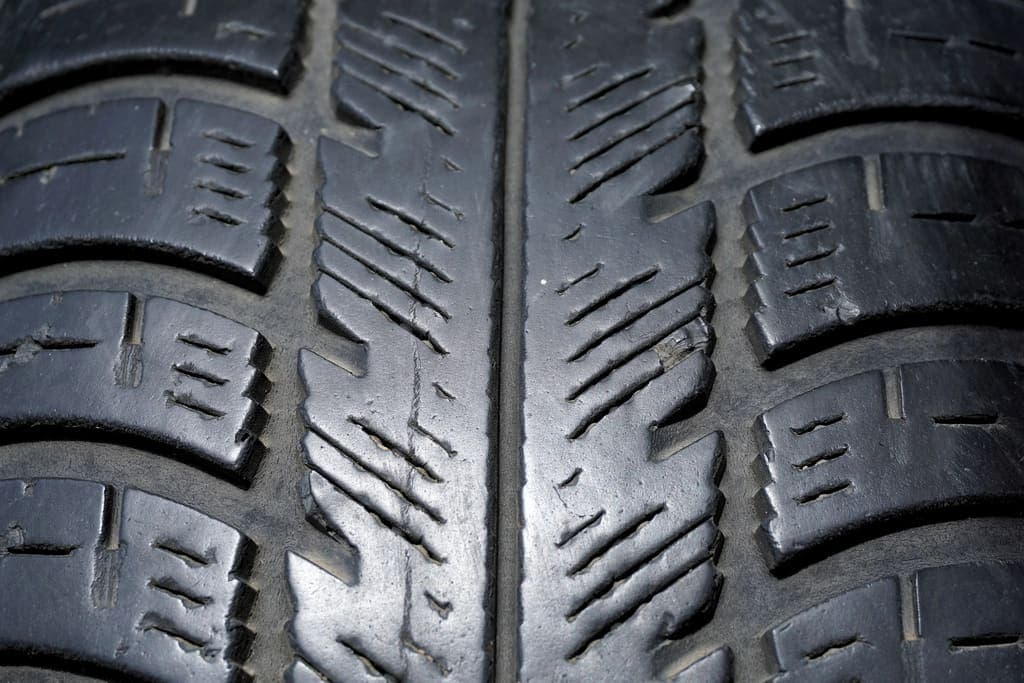
Feathering — smooth one way, sharp the other
Run your palm across the tread. If it feels smooth in one direction and like a saw in the other, that is toe misalignment. The tire is being dragged sideways slightly with every rotation.
Feathering is the most common thing we find on cars that have hit a Columbus pothole hard.
Cupping or scalloped patches
High and low spots around the circumference. Almost always worn shocks or struts letting the wheel bounce instead of holding it on the road.
Cupping also produces a rhythmic hum that people mistake for a wheel bearing. If the noise changes when you swerve gently side to side, suspect a bearing. If it does not, suspect cupping.
Flat spot in one place
A locked wheel at some point — hard braking on a car without functioning ABS, or a seized caliper dragging.
What about the penny test?
The classic test — insert a penny, Lincoln's head down, and if you can see the top of his head you are below 2/32" — is a legal minimum, not a safe one.
Wet braking distance degrades badly below 4/32". If you drive through Ohio winters, plan to replace nearer 4/32" rather than waiting for the legal limit.
Simple habits that double tire life
- Check pressures monthly, cold, including the spare
- Rotate every 5,000–7,500 miles — every second oil change is an easy rule
- Get an alignment check after any hard pothole hit or curb strike
- Replace shocks and struts before they destroy a set of tires
When it is balance and not alignment
A vibration that appears at a specific speed — usually somewhere between 55 and 70 mph — and goes away above and below it is balance. Alignment problems do not come and go with speed; they pull constantly.
Bring the car in and we will measure tread depth on all four, check pressures, and tell you which of the above you actually have. Tire and balancing service is one of the cheapest things you can do for a car, and one of the most ignored.
Filed under Tires & Wheels
+ Book an Appointment