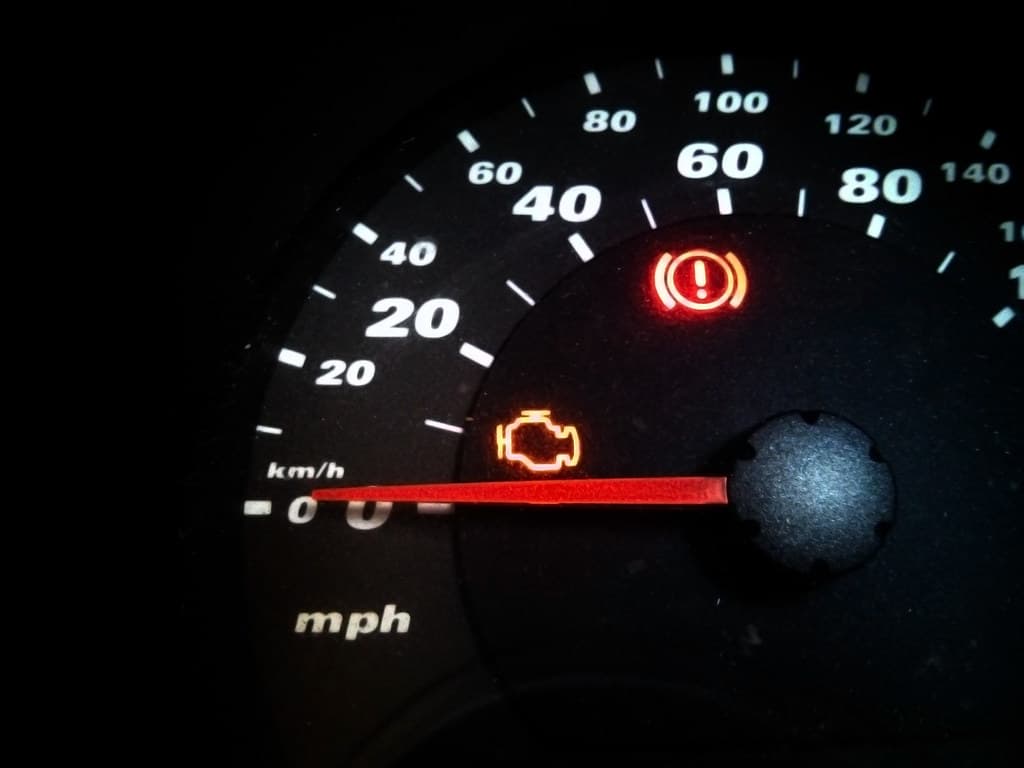
Steady or flashing changes everything. A guide to what the light means, why a free code read is not a diagnosis, and when to pull over immediately.
The check engine light is the most misunderstood warning on the dashboard. It is not a countdown to catastrophe, and it is not something to tape over. It means the engine computer noticed a reading outside the range it expects and stored a code about it.
The useful question is not "what is the code" — it is "what is the fault."
Steady versus flashing
Steady light: something is out of spec. The car is generally safe to drive to a shop, though fuel economy and emissions may suffer.
Flashing light: a misfire severe enough to dump raw fuel into the exhaust. That destroys catalytic converters, and converters are among the most expensive parts on the car. Pull over, stop driving, and call for a tow.
If your light is flashing right now, stop reading and call us.
The first thing to check costs nothing
Loose or cracked fuel caps are still one of the most common triggers. The evaporative emissions system pressure-tests the fuel tank; a cap that is not sealing fails that test.
Tighten it until it clicks, then drive for a day or two. Some cars clear the code themselves; others need it reset.
Why a free code read is not a diagnosis
Parts stores will read your code for nothing, and that is genuinely useful information. But the code names a circuit, not a part.
Take P0171 — "system too lean, bank 1." That code can be caused by:
- A vacuum leak in an intake hose or gasket
- A dirty or failing mass airflow sensor
- A weak fuel pump or clogged filter
- A leaking injector
- An exhaust leak upstream of the oxygen sensor
- The oxygen sensor itself
Replacing the oxygen sensor because the code mentions oxygen is how people end up spending three hundred dollars and still having the light on. The sensor was reporting the problem accurately; it was not causing it.
What real diagnosis involves
When we take a check-engine job, the time is spent on:
- Reading all stored and pending codes, plus freeze-frame data showing conditions when the fault occurred
- Watching live sensor data while the engine runs, looking for values that drift out of range
- Testing the circuit itself — voltage, ground, resistance — rather than assuming the sensor is at fault
- Smoke-testing for vacuum and evaporative leaks where relevant
- Confirming the repair by clearing codes and running the drive cycle
That is why there is a diagnostic fee. It is bench time, not a plug-in. If we do the repair, that fee comes off the job.
Codes people bring us most
| Code | Usually means | | --- | --- | | P0420 | Catalyst efficiency below threshold — often an exhaust leak or a failing sensor, not always the converter | | P0300 | Random misfire — ignition, fuel or compression | | P0171 / P0174 | Lean condition — vacuum leak is the first suspect | | P0442 | Small evaporative leak — start with the fuel cap | | P0128 | Coolant not reaching temperature — usually a stuck thermostat |
What not to do
Do not clear the code and hope. Clearing wipes the freeze-frame data that tells a technician what the car was doing when the fault triggered — the single most useful clue available. If you have already cleared it, that is fine, just tell us.
Bring us the light while it is still on. Book a diagnostic and we will tell you what is actually wrong before anyone buys a part.
Filed under Diagnostics
+ Book an Appointment