A shop that never measures a rotor is guessing in one direction or the other. Here is what the measurement is, why thin rotors warp, and when machining is genuinely the right call.
There are two ways to get a brake job wrong. Replace rotors that had thousands of good miles left, or machine rotors that were already too thin to survive it.
Both come from the same place: nobody put a micrometer on them.
What a rotor is doing
The rotor is the disc the pads squeeze. Its job is to convert your car's momentum into heat and then get rid of that heat fast enough to be ready for the next stop.
That second part is why thickness matters. A thicker rotor is a bigger heat sink. As it wears thinner, it holds less heat and sheds it more slowly, so the same braking gets it hotter. Hot rotors are what cause the problems people describe as warping.
Two numbers stamped on every rotor
Look at the hub or the edge of the rotor and you will find them cast or stamped in.
Nominal thickness is what it measured new. Minimum thickness — often marked MIN TH or DISCARD — is the point at which the manufacturer says it is no longer safe to use.
There is a third number that never gets stamped: machine-to thickness, the point below which it cannot be resurfaced and still end up above minimum. Cutting a rotor removes material from both faces, typically 0.030–0.060 inches total once it is trued.
The rule is straightforward. Measure it. If cutting it would take it below minimum, it gets replaced. There is no judgment call involved and no reason to guess.
Rotors do not really warp
This is the part that surprises people. The pulsing you feel through the pedal is almost never a bent rotor.
What you are feeling is thickness variation — some parts of the rotor are fractionally thicker than others, so the pads are pushed apart and released once per revolution. A few thousandths of an inch is enough to feel clearly.
Usually it comes from uneven pad transfer. Brake pads work partly by depositing a thin friction layer onto the rotor. Get a rotor very hot and then hold the car still on the pedal — at a long light, or on a hill — and the pad sits there cooking a patch of material onto one spot. Now there is a high spot, and every rotation the pads hit it.
That is why the fix is not always machining. Sometimes it is bedding the brakes in properly and changing the habit of holding the pedal hard at a light after heavy braking.
When resurfacing is the right answer
- The rotor measures with enough meat to cut and stay comfortably above minimum
- The surface has scoring, light grooving or uneven pad deposits
- There is no cracking, and no heat damage through the friction surface
- The rotor is a heavy casting worth machining in the first place
Resurfacing gives a fresh flat surface for the new pads to bed into, and on a decent rotor it is genuinely good work.
When it has to be replaced
- Measured thickness is at or near minimum before you cut anything
- Cracks, especially any crack reaching the outer edge
- Hard blue or purple heat spots that machining will not remove — those are hardened patches that will keep causing pulsation
- Deep grooving past what a cut can clean up
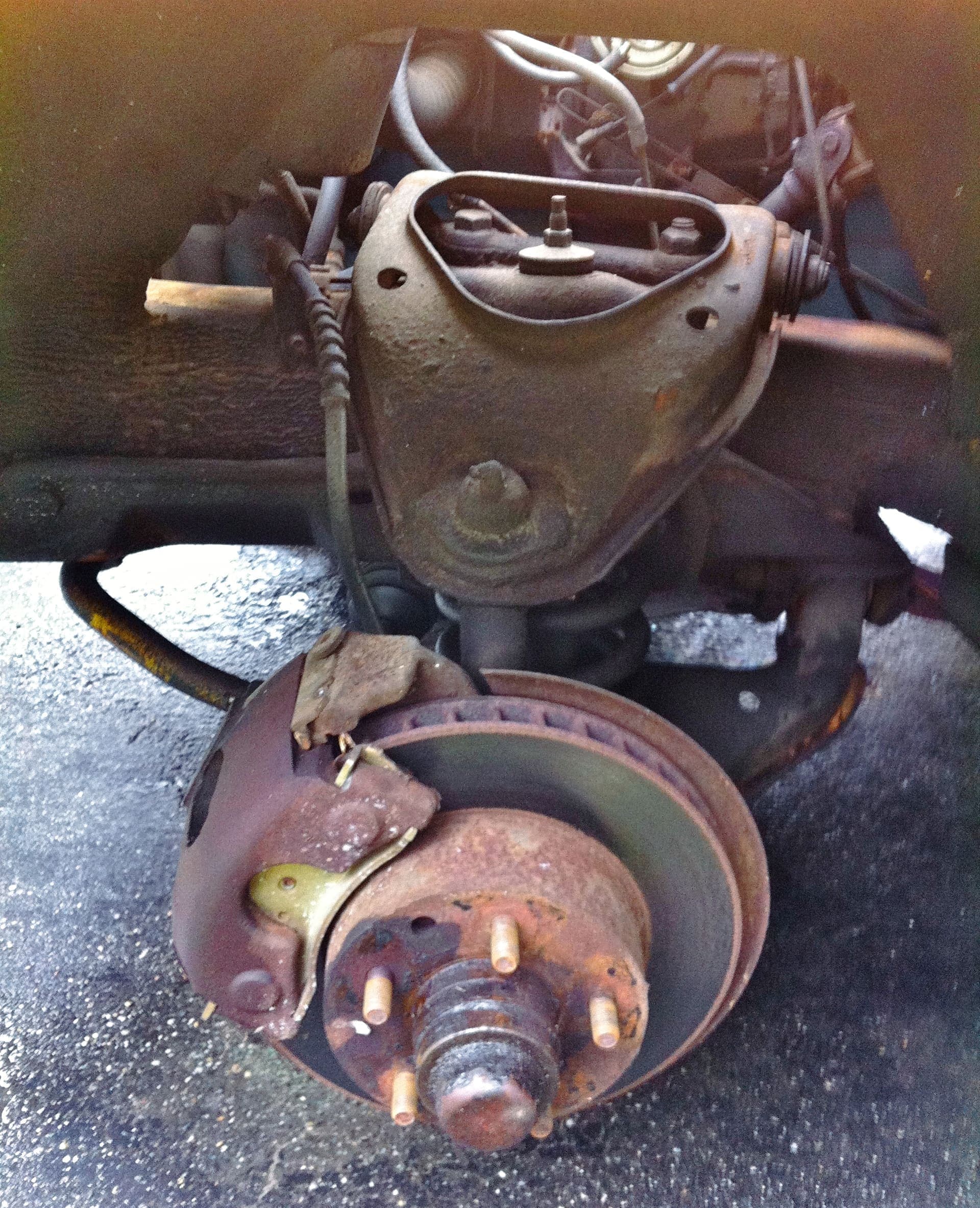
- Rust scaling on the inner face or in the cooling vanes, which is common on Ohio cars where the inner rotor face never gets cleaned by the pad
That last one puts more rotors out of service around here than wear does. Salt gets into the vanes and the rotor corrodes from the inside.
Why new rotors are often the cheaper answer now
Twenty years ago most rotors were heavy castings and machining them was obviously worth it. Many modern rotors are made thin and light for weight and fuel economy, with very little margin between nominal and minimum thickness.
On a lot of cars there is barely enough material to take one cut. Once you add the labour of setting up and machining, a new rotor costs about the same and gives full thickness and full heat capacity. That is not upselling — it is the arithmetic on a modern part.
What to ask any shop
Ask what the rotors measured, what the minimum is, and what the discard number is on your car. Any shop doing the job properly will have those three numbers written down, because they took them before deciding.
If the answer is that they always replace, or that they always machine, without reference to a measurement, that is worth knowing before the work starts.
We measure thickness and runout on every brake repair and quote from the numbers, which is also why our quotes sometimes come in under what people were braced for. Sometimes the rotors are fine.
Filed under Brakes & Safety
+ Book an Appointment